← Back to Case Studies
Preserving Streaming Experience Through Protocol Offload
Reducing latency and variability by aligning system architecture with user expectations for smooth, continuous media playback.
At a Glance
The Challenge: Performance Variability Users Can Feel
Streaming media workloads are highly sensitive to latency, consistency, and timing. Even when average throughput appears acceptable, brief spikes in processing time can disrupt playback, resulting in stutters, dropped frames, or inconsistent quality that users immediately notice.
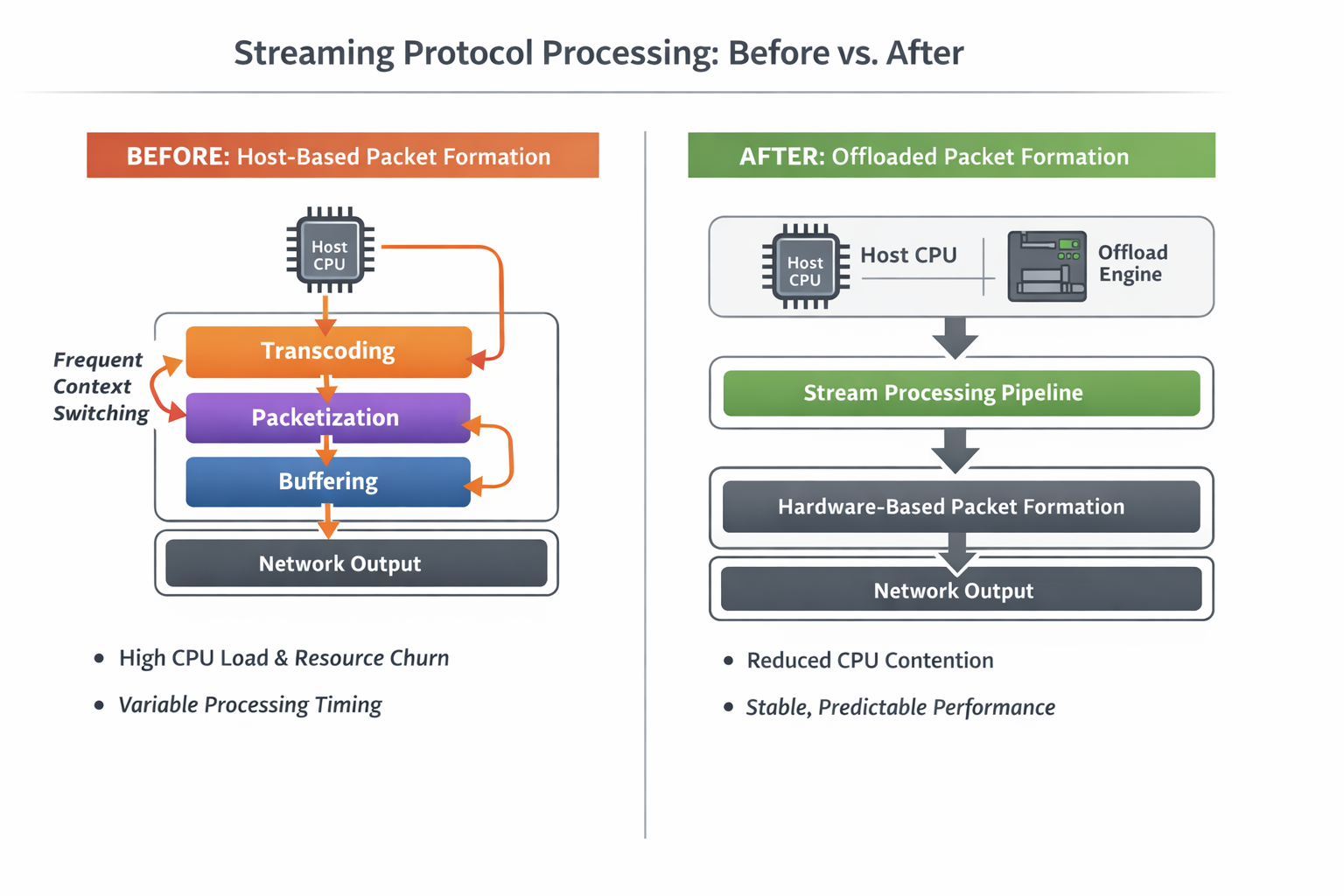
In traditional streaming architectures, media flows frequently transition between different transcoding stages as content is processed, packaged, and delivered. These transitions introduce significant CPU overhead and resource churn, particularly under load, as the system repeatedly switches contexts and reallocates processing resources. While cheaper storage and flexible processing pipelines reduce infrastructure costs, they often shift complexity and variability into the execution path.
As load increases, this variability becomes difficult to predict or control. Playback quality degrades in ways that feel arbitrary to users, even when the system is operating within expected parameters. The core challenge was not maximizing peak performance, but reducing unnecessary overhead and variability so that streaming behavior remained smooth, consistent, and aligned with user expectations.
Target Users and Their Needs
Media streaming performance impacts multiple user groups, each experiencing variability in different ways. A successful solution needed to preserve smooth playback for end users while giving engineers and platform teams a predictable, controllable execution model under load.
- End Users (Viewers and Listeners): Needed uninterrupted playback, consistent quality, and behavior that did not degrade unpredictably under load.
- Application and Media Developers: Needed stable streaming performance so applications behaved consistently across devices and workloads without complex tuning or workarounds.
- Platform and System Architects: Needed an execution model that reduced variability, aligned responsibility with hardware capabilities, and supported streaming workloads predictably.
- Validation and Performance Engineers: Needed deterministic behavior to reproduce issues, measure improvements, and reason about performance without chasing intermittent failures.
My Role: UX Architect & Systems Designer
I led the UX-driven architectural effort to protect media streaming quality by addressing the root causes of performance variability in the execution path. Rather than treating playback issues as application-level problems, I focused on how system responsibilities were assigned and how those decisions affected user-perceived smoothness under load.
- Identified points of unnecessary overhead and resource churn introduced by repeated transcoding transitions in the streaming pipeline.
- Translated user expectations for consistent playback into architectural requirements around execution predictability.
- Collaborated with platform, network, and firmware engineers to evaluate where protocol responsibilities could be reassigned to reduce variability.
- Defined architectural models and data flows that favored predictable execution and reduced context switching, even when leveraging lower-cost storage and flexible processing pipelines.
- Contributed to invention and patent development to formalize the approach and guide future implementation.
This work centered on aligning system behavior with how users actually experience streaming media, ensuring architectural decisions protected experience quality rather than optimizing isolated components.
Solving the Problem: Reducing Variability Through Architectural Offload
To reduce performance variability in media streaming, this work reframed packet formation and protocol handling as an architectural responsibility rather than a byproduct of application-level processing. The core idea was to minimize unnecessary context switching and resource churn introduced by repeated transcoding transitions along the streaming pipeline.
Instead of assembling and processing streaming protocol packets on the host CPU alongside other competing workloads, the proposed architecture shifted packet formation responsibilities closer to the hardware. By offloading this work, the system reduced CPU contention and decoupled streaming execution from transient load on the host, resulting in more predictable timing and smoother playback behavior.
- Reducing execution churn: Limited transitions between transcoding stages and minimized repeated packet assembly work to reduce overhead that contributed to playback instability.
- Protecting experience consistency under load: Stabilized execution timing so quality degraded gracefully rather than unpredictably as load increased.
- Aligning system responsibilities with user expectations: Prioritized continuity and smoothness over optimizing isolated component efficiency.
- Supporting cost-conscious infrastructure choices: Enabled continued use of lower-cost storage and flexible pipelines while preventing those tradeoffs from leaking into the user experience.
This solution treated performance variability as a UX problem rooted in system design, using architectural offload to preserve experience integrity even in constrained or highly loaded environments.
Design & Architecture Rationale
This work started from a user experience problem rather than a hardware optimization goal. Viewers experience streaming quality as continuity, predictability, and trust. When playback stutters or degrades unpredictably, the user does not care which subsystem caused it.
I framed the architecture around protecting user-perceived smoothness under load. That meant looking beyond isolated throughput metrics and focusing on where execution churn, packet formation, and host CPU contention could leak into the playback experience.
Key tradeoffs included:
- Moving complexity closer to the platform layer so the user-facing experience could remain simpler and more predictable.
- Treating performance consistency as part of the product experience rather than only a low-level implementation concern.
- Framing the architecture around perceived playback quality instead of only raw throughput or subsystem metrics.
Scope and Implementation Status
This work focused on defining and formalizing an architectural approach to reducing performance variability in media streaming systems through protocol offload. The resulting concepts and system models were captured as part of a patent filing intended to guide future platform evolution.
While the approach was designed to be integrated incrementally, it was not implemented in shipping products during my tenure. Adoption depended on future resourcing, funding, and alignment with longer-term platform and hardware roadmaps. As a result, the primary outcome of this effort was establishing a clear, UX-driven architectural direction rather than delivering an immediate product change.
This case study reflects ownership of the experience framing, architectural design, and invention, with the intent that the work could be incorporated when platform priorities and investment allowed.
Results, Impact, and Influence
Although the architecture was not implemented in shipping products during my tenure, this work influenced how streaming performance problems were framed and discussed across platform and architecture teams. Rather than treating playback instability as an application or tuning issue, it established performance variability as a system-level responsibility with direct UX implications.
As part of this effort, I authored and co-authored a patent filing that formalized the architectural approach to reducing streaming variability through protocol offload. The patent captured the UX-driven rationale, system model, and intended integration path, providing a durable reference for future roadmap planning.
Key outcomes included:
- Reframed streaming performance issues around predictability and user-perceived quality rather than raw throughput.
- Established a clear architectural model for reducing transcoding overhead and execution churn in streaming pipelines.
- Provided a concrete, UX-aligned direction that could be evaluated and adopted when resourcing and platform priorities allowed.
- Informed longer-term discussions about hardware and platform responsibilities for protecting media playback quality under load.
This work created a foundation for addressing streaming performance in a way that preserved experience integrity, even when infrastructure decisions prioritized cost efficiency and flexibility.
Why This Work Matters
Media streaming sets a high bar for user experience. Viewers expect smooth, uninterrupted playback, and even small disruptions are immediately noticeable and erode trust in the product. When performance degrades unpredictably, users rarely attribute the issue to system load or architectural tradeoffs, they simply experience a broken experience.
This work demonstrates how UX concerns can and should shape low-level architectural decisions. By treating performance variability and transcoding overhead as experience problems rather than isolated technical inefficiencies, the solution aligned system responsibilities with how users actually perceive streaming quality.
Across my work, this project reinforces a consistent approach: identify where system behavior violates user expectations, then redesign the architecture so those expectations are protected by design. Whether the solution lives in a UI, a service boundary, or hardware offload, the goal is the same, build systems that behave in ways users can trust, even under load and constraint.