← Back to Case Studies
Firmware Update UX Architecture
Firmware updates are one of the most failure-prone and mistrusted interactions users have with hardware systems. Ambiguous progress indicators, limited recovery options, and high-impact failure modes often lead users to delay updates, escalate support issues, or avoid the process entirely.
This project re-architected firmware update workflows from a UX-first perspective, transforming a high-risk, opaque operation into a predictable, explainable, and recoverable experience backed by robust system design.
At a Glance
The Challenge: Opaque, High-Risk Update Experiences
Firmware updates sit at the intersection of high technical risk and low user tolerance for failure. For users and administrators, the update process was often opaque, unforgiving, and difficult to trust. When something went wrong, recovery paths were unclear, and even successful updates provided little confidence that the system was left in a known-good state.
Across products and teams, the same issues surfaced repeatedly:
- Update progress was ambiguous or misleading, offering little insight into what the system was actually doing.
- Failure modes were poorly communicated, leaving users unsure whether to retry, wait, or escalate.
- Partial updates could leave devices in degraded or unrecoverable states.
- Support teams lacked the visibility needed to diagnose issues quickly.
- Validation teams struggled to reason about update state and reproducibility.
Target Users and Their Needs
- End Users / IT Administrators: Needed confidence that updates were safe to apply, clear feedback on progress and outcomes, and guidance when intervention was required.
- Validation Engineers: Required deterministic update behavior, clear state transitions, and the ability to reproduce and diagnose failures during testing.
- Support Engineers: Needed visibility into update state, failure reasons, and recovery paths to resolve issues quickly without manual device access.
- Platform and Firmware Engineers: Required a structured update model that reduced edge cases, supported future evolution, and aligned system behavior with user-facing promises.
My Role: UX Architect & Design Lead
- Synthesizing customer and internal feedback into clear experience requirements and failure-mode priorities.
- Defining user flows, states, and decision points for update progress, intervention, and recovery.
- Partnering with firmware and platform engineers to align system behavior with user-facing promises.
- Creating artifacts to drive alignment, including UX flows, state diagrams, and architecture-level interaction models.
- Influencing implementation details where needed to ensure the experience was predictable, diagnosable, and recoverable.
Solving the Problem: UX-Driven Update Architecture
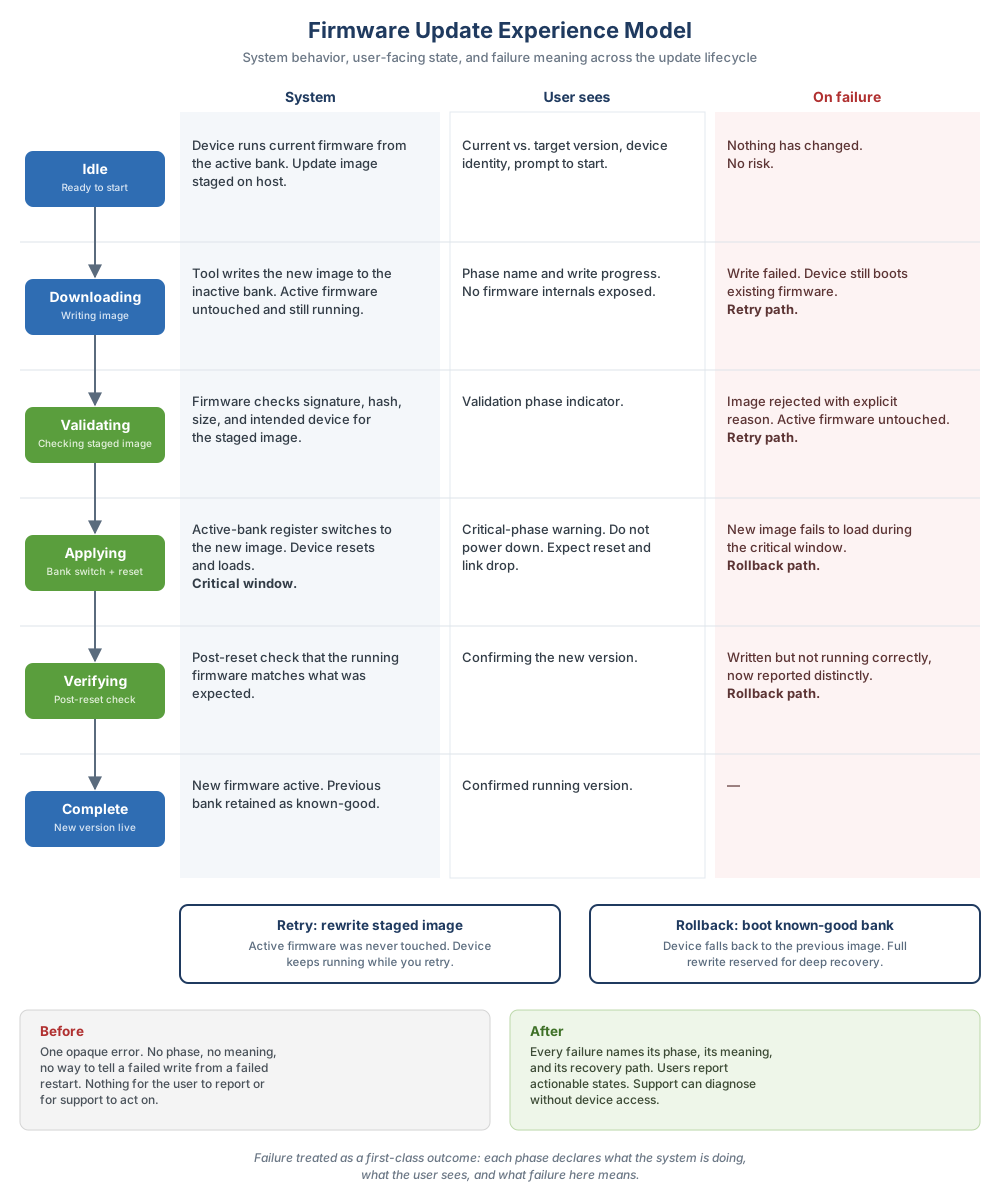
Rather than treating firmware updates as a single linear operation, this work reframed updates as a series of explicit, observable states with well-defined transitions. Each state represented a meaningful phase of the update process that could be communicated clearly to users and reasoned about by engineers.
Key principles guided the architecture:
- Explicit state modeling: Update progress was defined in terms of concrete system states rather than inferred UI milestones, allowing the experience to reflect what the system was actually doing.
- Predictable transitions and outcomes: State transitions were designed to be deterministic, enabling users and support teams to understand when intervention was required and what actions were safe.
- Recoverability by design: Failure states were treated as first-class outcomes, with defined recovery paths that minimized the risk of leaving devices in unusable or ambiguous conditions.
- Alignment between system behavior and UX: The user interface was designed to surface system truth, reducing the gap between what the system knew and what users were shown.
Design & Architecture Rationale
The core design decision was to stop treating firmware updates as a vague progress bar and start treating them as an observable system state model. Users did not need every internal detail, but they did need confidence that the system was progressing, recoverable, and honest about failure.
I mapped the update experience around the states users and support teams actually cared about: preparing, applying, validating, recovering, retrying, and completing. Each state needed a clear owner in the system, a user-visible explanation, and a safe next action when something went wrong.
Key tradeoffs included:
- Balancing technical accuracy with user comprehension so administrators got enough detail to trust the process without being overwhelmed by firmware internals.
- Exposing failure states clearly enough for support and recovery while avoiding alarmist messaging during normal update transitions.
- Aligning user-facing promises with what the firmware, validation logic, and support diagnostics could reliably prove.
UX Architecture Flow (Visual Overview)
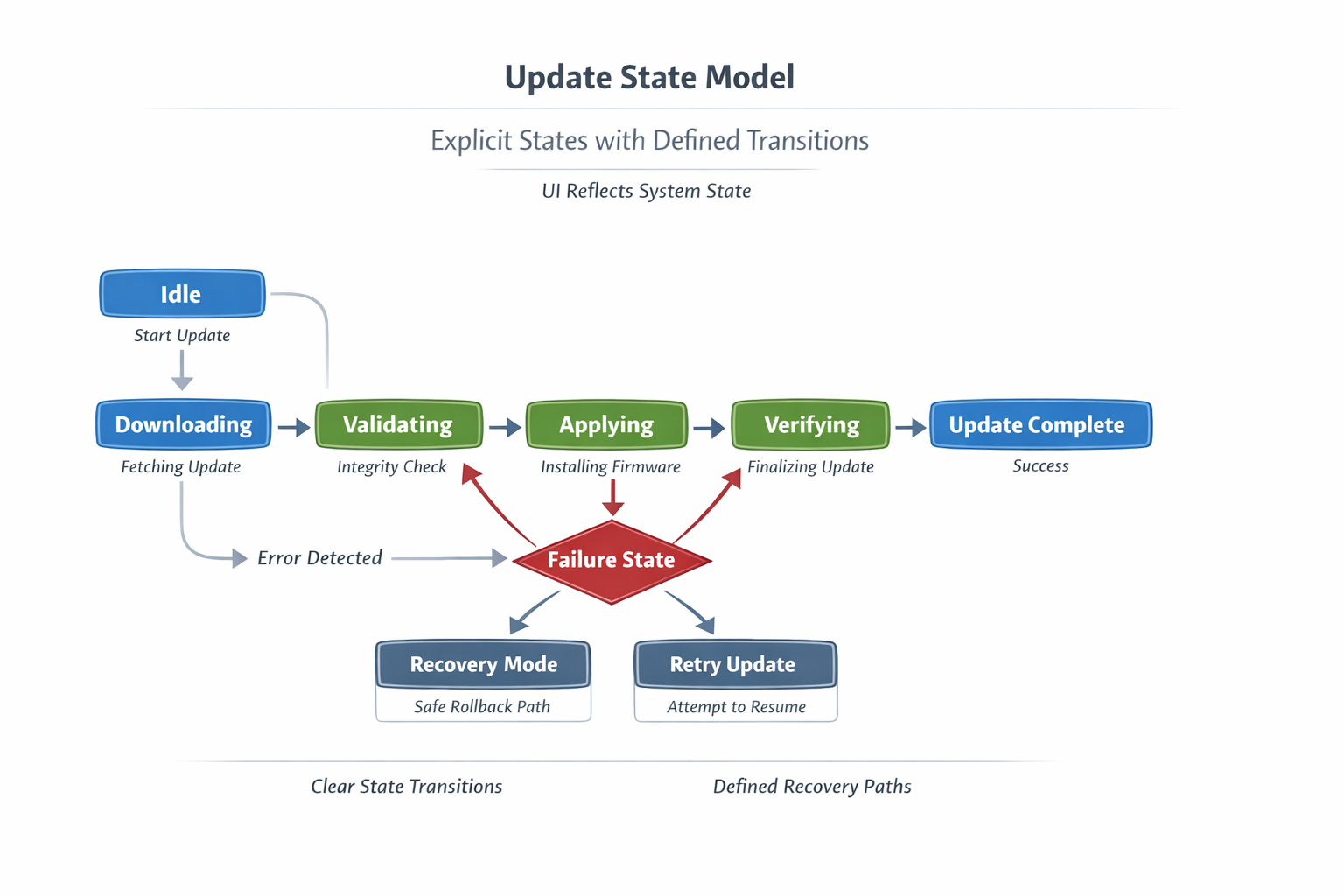
Explicit update states with defined transitions, failure handling, and recovery paths. Click to open full size.
Scope and Implementation Status
This effort focused on defining and formalizing a UX-driven firmware update architecture intended to address systemic failure modes across products and deployment contexts. The resulting designs and inventions were captured in granted and pending patents and used to guide future implementation planning.
While elements of this approach informed ongoing discussions and internal planning, the full architecture was not implemented in shipping products during my tenure due to the long lead times and coordination required for hardware and silicon changes. The primary outcome of this effort was establishing a clear, defensible update model that aligned user experience requirements with system behavior and could be adopted incrementally over time.
Before & After
Before
- Implicit update state inferred by the UI
- Ambiguous progress indicators
- Failure surfaced late or not at all
- No clear recovery or retry model
- Support lacked diagnostic visibility
After
- Explicit, modeled update states
- Progress tied directly to system behavior
- Failure treated as a first-class outcome
- Defined recovery and safe retry paths
- Improved visibility for validation and support
Results & Impact
The full architecture was not implemented in shipping products during my tenure, but the work had real influence across teams and was formalized in granted and pending patents that codified the UX-driven update model and provided a durable reference for future platform development.
- Established a shared mental model for firmware update state, failure, and recovery across UX, firmware, validation, and support teams.
- Shifted conversations from UI-level fixes to system-level responsibilities for user trust and safety.
- Reduced ambiguity in update behavior, failure handling, and support expectations during design and validation phases.
Related Patents
- US12254304B2 – Firmware update techniques
- US12001826B2 – Device firmware update techniques
Why This Work Matters
Firmware updates represent one of the highest-risk interactions users have with hardware systems. When update workflows fail, the cost is measured not just in support burden or recovery effort, but in lost trust and delayed adoption.
This work demonstrates how UX can serve as an architectural input, not just a layer applied after implementation. By grounding system design in user needs, failure awareness, and recoverability, it establishes a pattern for building experiences that remain credible even under failure conditions.